
The Silver Lining in the Recent Bullion Price Increase: The Zakat Angle
Zakat is one of the five fundamental pillars of Islam, and one of its most important principles is that a person is either a Zakat giver or a Zakat recipient.
A person who is Sahib-e-Nisab (Urdu) — known in Arabic as Ṣāḥib al-Niṣāb — is obligated to pay Zakat. As established by the Sunnah of Prophet Muhammad ﷺ and agreed upon in Islamic jurisprudence (Fiqh), the Nisab threshold is defined as the lower of:
• 87.48 grams of gold, or
• 612.36 grams of silver
The monetary value of Nisab therefore fluctuates with market prices and must be calculated using prevailing bullion rates. If a person’s zakatable assets (cash, savings, investments, receivables, etc.) exceed the Nisab for one full lunar year, Zakat becomes due at 2.5% (1/40th).
Most contemporary scholars recommend using the lower silver-based Nisab, as this ensures broader social support and aligns better with the maqāṣid (objectives) of Zakat.
Nisab values using current bullion prices (as of 9 January 2026 – approximate)
Using prevailing spot prices:
India (INR) adjusted for Custom Duties levied in India
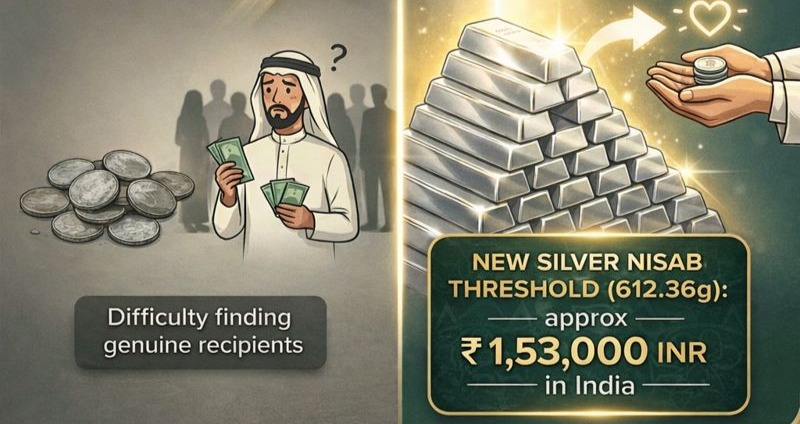
• Silver @ ~₹250 per gram → ₹1,53,000 (612.36 g)
• Gold @ ~₹13,815 per gram → ₹12,09,000 (87.48 g)
United States (USD)
• Silver @ ~$2.50 per gram → ~$1,535
• Gold @ ~$145 per gram → ~$12,680
👉 Since the silver Nisab remains lower, it continues to be the operative threshold for Zakat calculation.
Why this matters — especially now
From a practical standpoint, one of the greatest challenges today is identifying genuine Zakat recipients.
• Truly needy individuals often do not ask, due to dignity and shame
• Many visible beggars are unfortunately professionalised
• When the silver Nisab had fallen sharply in recent years — especially when the gold-silver ratio stretched beyond ~ 90:1 (it exceed 100 in May 2025 and is currently at 57.1) — even individuals holding ₹15,000–₹20,000 in zakatable assets (including refundable rental deposits, which most scholars classify as amānah and zakatable) were technically disqualified from receiving Zakat.
This led to an uncomfortable paradox:
➡️ People in genuine distress (medical emergencies, loss of income, accidents, rent defaults) were rendered non-eligible, while
➡️ Zakat payers struggled to find legitimate recipients
The recent phenomenal rise in bullion prices — particularly silver — has meaningfully corrected this imbalance — a proverbial Silver Lining!
Let me explain…
By raising the effective silver-based Nisab to a more realistic level, Zakat is once again reaching those it was meant to protect, and for the first time in many years, many deserving families genuinely feel supported through this divinely mandated system.
Ideally, some of these cases should have been supported through Ṣadaqah, but the reality is that Zakat itself is not paid properly or fully by most people. While precise data is unavailable, I would be surprised if even 10% of those upon whom Zakat is due are paying their correct amounts, on time, and with proper calculation.
In that context, the recent move in silver prices offers a quiet but powerful silver lining — restoring balance, dignity, and purpose to one of Islam’s most profound economic institutions.